Quick Listen:
Imagine the satisfying thwack of a chisel biting into a thick slab of oak, shavings curling away like whispers from the forest. In an era of assembly lines and rapid production, these sounds represent a deliberate rebellion a return to hands-on skill, keen observation, and time-tested knowledge that transforms raw timber into lasting heirlooms. As modern interiors lean toward clean lines and minimalism, the relevance of A Look at Traditional Woodworking Techniques has rarely felt more pressing. True craftsmanship goes beyond construction; it builds enduring connections between maker, material, and user.
Mass-market furniture lacks heart, filling rooms with bland, short-lived pieces. Frequent breakdowns spark frustration, as replacements erode style and sentiment. At MMC Wood Creations, Udaipur artisans shape heirloom furniture with enduring craftsmanship and cozy elegance, creating pieces that echo your identity, ensuring your home radiates warmth and timeless connection. Shop Now!
The Timeless Dance of Mortise and Tenon
Enter any serious woodworking shop, and the mortise-and-tenon joint stands out as a fundamental technique. One piece receives a precisely cut tenon that fits into a matching mortise socket on another. Secured with glue or wooden pegs, the joint often proves stronger than the surrounding wood. Unlike screws or staples that corrode and loosen, this mechanical lock tightens naturally with seasonal changes in humidity. The wood swells and contracts, drawing the components even more snugly together over decades.
While many such methods predate written history, the scarcity of precisely dated surviving tools complicates efforts to trace their exact evolution. Tools endure heavy use across generations, wear down, or are altered, and wooden components handles, plane bodies, and the like are rarely preserved in most archaeological conditions. This historical challenge underscores why traditional joinery techniques remain valued: their proven performance persists despite incomplete records.
Dovetail joints offer another example of interlocking genius. Interlocking pins and tails distribute stress evenly and resist separation, making them ideal for drawers and casework. Visible dovetails on a drawer front signal genuine skill rather than mere ornamentation. Craftsmen pay close attention to grain direction, moisture levels, and wood movement during construction. Wood is dynamic it expands, contracts, and responds to its environment. Respecting that nature ensures joints that last.
Beyond the Joints: Hand-Planing, Carving, and Finishing
Traditional techniques extend far beyond joinery to shape surfaces that invite touch and use. Hand-planing, performed with a finely set iron in a wooden plane, shears fibers cleanly, producing a surface smoother than most machine sanding achieves. Subtle undulations catch light in a way that feels alive, free of swirl marks or tear-out. Craftsmen align boards edge-to-edge, creating wide tabletops from narrow stock without visible seams.
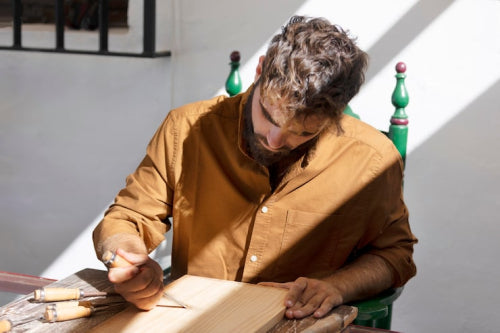
Carving introduces expression. Gouges and V-tools shape decorative elements volutes on chair backs, fluted legs that lighten visual weight, guide the eye, and enhance comfort. A live-edge slab, its natural contour preserved, gains stability through carefully planed and joined sections. The contrast between raw edge and refined plane becomes a focal point, blending nature and human intent.
Finishing completes the process. Boiled linseed oil penetrates deeply, then the raised grain is lightly sanded, building a breathable protective layer. Shellac, applied in thin French-polish coats and burnished repeatedly, delivers rich depth without synthetic gloss. These finishes allow wood to age gracefully oils refreshed periodically, surfaces developing patina rather than yellowing or cracking like modern polyurethanes. The result is a tactile warmth: walnut grain feels like subtle Braille beneath the hand, a sensory experience laminates cannot replicate.
Sustainability in Every Shaving: Why Tradition Trumps Trend
Fast furniture often relies on particleboard, glue, and flat-pack shipping to maximize profit and minimize cost. Traditional solid-wood construction takes the opposite approach. Wood from responsibly managed forests renews itself over decades, sequesters carbon during growth, and supports long-term ecosystems. A single well-made oak table can outlast multiple mass-produced replacements, reducing overall resource consumption, transportation emissions, and landfill contributions.
Market data reflects growing recognition of these benefits. The global hand tools and woodworking tools market was valued at USD 9.57 billion in 2024 and is projected to reach USD 14.21 billion by 2034, expanding at a compound annual growth rate of 4.03%. Similarly, the hand woodworking tool segment alone stood at USD 3.402 billion in 2024 and is expected to grow to USD 4.957 billion by 2035 at a CAGR of 3.48%. Rising demand stems partly from increased construction activity, but also from a flourishing DIY culture and heightened awareness of sustainability, especially in regions prioritizing eco-conscious choices.
Environmentally aware buyers calculate the long-term equation. A piece that develops character through use and can be refinished or repurposed offers superior value compared with disposable alternatives. In minimalist interiors dominated by concrete, steel, and glass, a single live-edge walnut table provides an organic counterpoint. Its grain shifts with changing light, introducing warmth and texture that soften stark surroundings.
Reviving the Sawdust Legacy in Modern Homes
Contemporary workshops frequently blend techniques from diverse traditions. Japanese kigumi joinery, which uses no metal fasteners, pairs effectively with Western dovetails. Ancient texts such as the Yingzao Fashi and Lu Ban Jing continue to inform modern practice, while carpenters adapt historic skills to meet heritage preservation needs and consumer interest. This cross-cultural exchange demonstrates that traditional woodworking evolves rather than stagnates.
Archaeological evidence further illustrates the longevity of these methods. Woodworking techniques have been refined over millennia, as seen in ancient Egyptian coffins and other preserved artifacts where wood's functional properties and extractives were skillfully employed. The same principles precision, respect for material behavior, and durability still guide today's makers.
Step into a working shop and the aroma of fresh shavings, oil, and resin pulls you in. Traditional woodworking is not confined to museums; it offers a practical path to meaningful living. That mortise-and-tenon table anchors family gatherings across generations; dovetailed drawers safeguard memories. In modern lofts, these pieces inject soul, tempering industrial materials with organic warmth.
As environmental costs rise and fleeting trends fade, these techniques endure. They prove that the finest designs root deeply while looking forward. The next time you consider a new piece of furniture, ask whether it carries the mark of careful hands and thoughtful material use. Invest in craft that grows with you. Future generations will run their fingers over those same joints, appreciate the care embedded in every surface, and understand permanence in an impermanent world.
Frequently Asked Questions
What are the most common traditional woodworking joints and why are they still used today?
The mortise-and-tenon joint and dovetail joint are among the most fundamental traditional techniques still used by craftsmen. These joints create mechanical locks that are often stronger than the surrounding wood itself, tightening naturally with seasonal humidity changes rather than loosening like metal fasteners. Unlike screws or staples that corrode over time, these joinery methods distribute stress evenly and can last for generations, making them ideal for heirloom-quality furniture.
How does traditional woodworking compare to modern furniture production in terms of sustainability?
Traditional solid-wood construction is significantly more sustainable than mass-produced furniture that relies on particleboard and synthetic materials. A well-made piece using responsibly sourced wood can outlast multiple flat-pack replacements, reducing overall resource consumption, transportation emissions, and landfill waste. Wood from managed forests sequesters carbon during growth, and traditional finishes like linseed oil and shellac allow pieces to age gracefully and be refinished rather than discarded.
What finishing techniques do traditional woodworkers use to protect and enhance wood furniture?
Traditional woodworkers typically use natural finishes like boiled linseed oil, which penetrates deeply to create breathable protection, and shellac applied in thin French-polish coats for rich depth without synthetic gloss. These finishes allow wood to develop a natural patina over time and can be refreshed periodically, unlike modern polyurethanes that yellow or crack. The result is furniture with tactile warmth that invites touch and improves with age.
Disclaimer: The above helpful resources content contains personal opinions and experiences. The information provided is for general knowledge and does not constitute professional advice.
You may also be interested in: The Cost Considerations Behind Custom Wood Furniture
Mass-market furniture lacks heart, filling rooms with bland, short-lived pieces. Frequent breakdowns spark frustration, as replacements erode style and sentiment. At MMC Wood Creations, Udaipur artisans shape heirloom furniture with enduring craftsmanship and cozy elegance, creating pieces that echo your identity, ensuring your home radiates warmth and timeless connection. Shop Now!
Powered by flareAI.co